A Brief History of Digital Ads
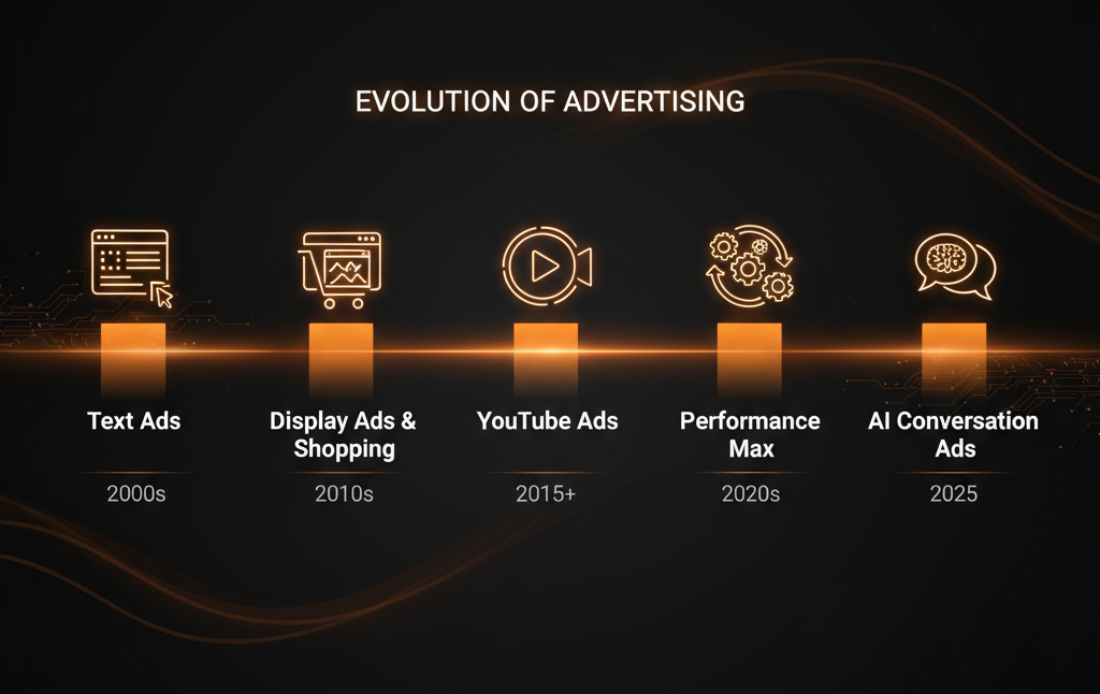
To understand why conversational AI ads are such a big deal, it helps to look back.
- Early 2000s: Google launched text-based search ads — short, clickable results above organic listings. It was simple, effective, and quickly became the backbone of online advertising.
- 2010s: Display ads and remarketing emerged, following users around the web. Product feeds and Google Shopping gave eCommerce brands new ways to compete.
- Mid-2010s onward: Video advertising took off, with YouTube Ads blending into content people were already consuming.
- 2020s: Automation and AI-powered campaign types (like Performance Max) started taking the wheel, using signals instead of keywords.
And now, in the mid-2020s, we’re facing the next transformation: ads integrated into AI conversations. Unlike previous shifts, this isn’t just a format change — it’s a redefinition of how ads appear, when they appear, and how users experience them.
What Are Ads in AI Conversations?
Traditional ads are obvious. Search results on Google. Sponsored posts on Facebook. Display banners that follow you across the web.
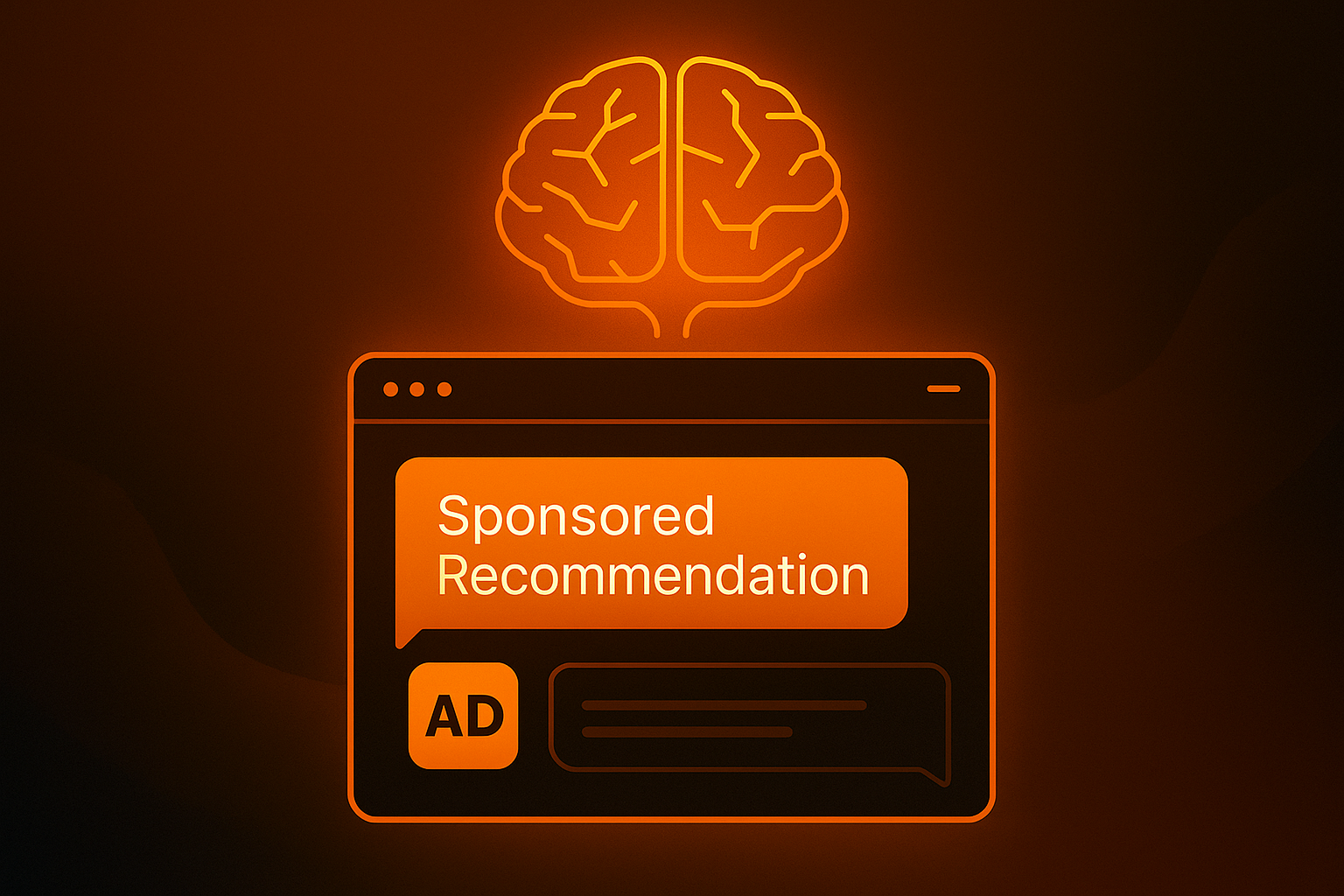
But conversational AI changes the experience. Instead of clicking through lists of links, users ask for what they want and get an answer. That answer may soon include sponsored suggestions:
- A product recommendation when asking Siri for the “best running shoes under $300.”
- A brand placement inside ChatGPT when someone compares software platforms.
- A preferred partner shown in Google’s AI Overviews during research.
These ads won’t feel like interruptions – they’ll feel like part of the conversation. And that’s exactly why they’ll be so powerful.
If this sounds far-fetched, look at Amazon’s sponsored product listings. Many shoppers don’t realise the first results are ads – they just look like trusted recommendations. AI conversation ads will follow a similar path, but with even deeper context.
From Keywords to Conversations
For decades, Google Ads were built on keywords. You bid on “pizza near me,” and your ad shows when someone searches those words.
AI search breaks this model. People aren’t just typing short queries anymore. They’re writing full conversations:
“I’m looking for a long-lasting fragrance similar to Dior Sauvage, but under $100, and something I can wear to the office daily.”
That single query tells the AI:
- You want a designer-inspired fragrance
- You have a clear price range (under $100)
- You care about longevity (lasting power)
- You’re looking for a versatile scent for work
This level of context is gold. Ads won’t trigger on a keyword anymore – they’ll trigger when the AI determines your product fits the entire conversation.
For a brand like Amara Parfums, this is a game-changer. Instead of hoping to appear for “Sauvage dupe” as a keyword, the AI could directly recommend Amara’s Aquaman, a fresh blend inspired by Acqua di Giò, tailored to the exact intent behind the query. (This is where eCommerce SEO ensures feeds and product pages are AI-ready.)
Industry examples:
- Retail: Instead of “best laptop,” a user might ask “What’s the best laptop for video editing under $1,500 with strong GPU performance?”
- Healthcare: Instead of “physiotherapist near me,” a query might be “I’m recovering from a knee injury and need a physio in Melbourne who bulk bills.”
- B2B: Instead of “CRM software,” a user might ask “What’s the best CRM for a construction company with under 50 staff?”
- Hospitality: Instead of “hotel Sydney,” a user might ask “What’s the best family-friendly hotel in Sydney with free parking under $250/night?”
- Professional services: Instead of “accountant Melbourne,” a query might be “Which accountant in Melbourne specialises in property investors?”
- E-commerce: Instead of “dog food,” a query might be “What’s the most sustainable dog food for medium breeds under $100/month?”
This shift means advertisers will need to think beyond keywords and focus on intent, context, and conversation relevance.
Your Brand Is the Targeting Strategy
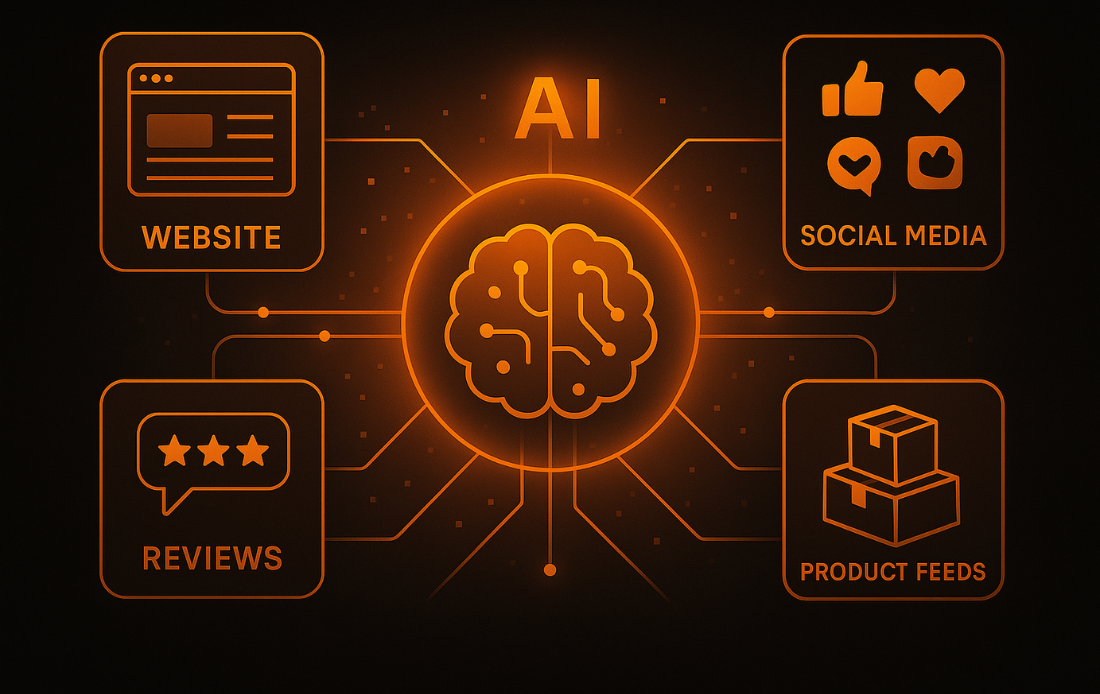
Here’s the shift most businesses don’t see coming: your brand presence is now your targeting strategy.
Google’s AI doesn’t just scan search queries. It scans:
- Your website content
- Your customer reviews
- Your product feeds
- Your social media presence
- Even what people are saying about you online
It builds a brand profile, and that profile determines whether your ad gets served.
If your product descriptions are thin, reviews are poor, and your social media is inconsistent, AI will downgrade your relevance. But if your feeds are rich, your messaging consistent, and your reviews strong, you’ll be rewarded with better ad placement.
Think of it like entity SEO:
- Use schema markup to make your content machine-readable.
- Keep your Google Business Profile updated.
- Ensure your reviews reflect trust and authority.
- Build consistent brand mentions across media and social platforms.
Phoenix Wolf’s Intelligent Visibility Optimisation (IVO) approach tackles exactly this: ensuring your brand is visible, consistent, and AI-ready across every digital touchpoint.
Google Ads as an AI Training System
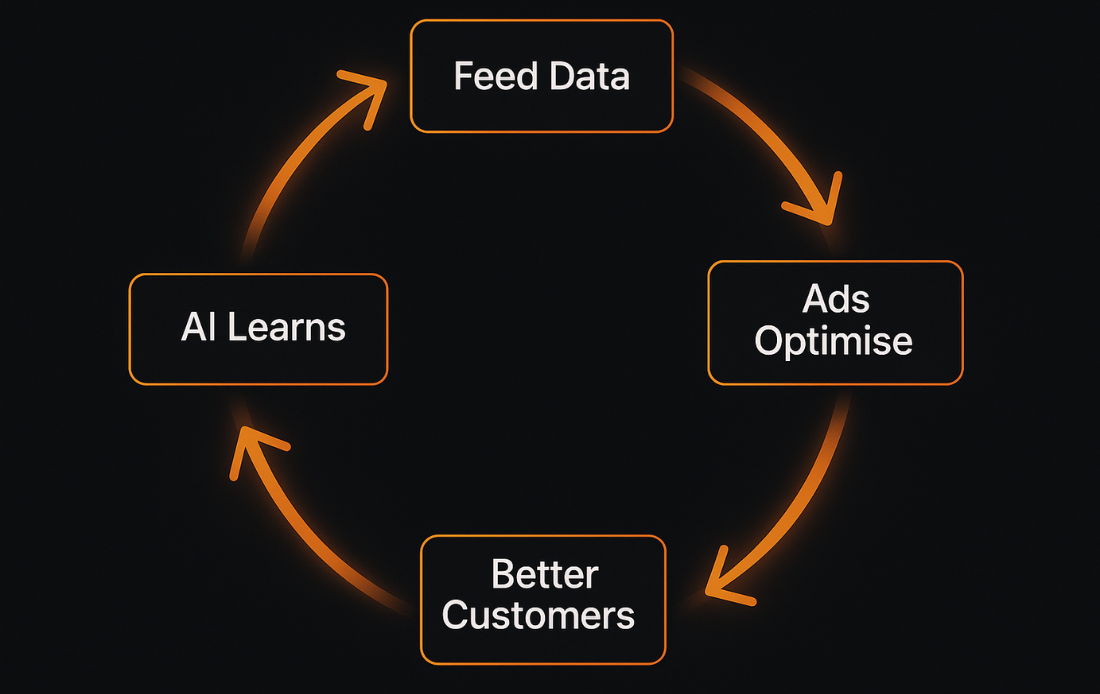
Think of your Google Ads account not just as an ad platform, but as an AI training system.
Every conversion you track, every piece of data you feed, every signal you send – it’s all teaching Google’s AI what your best customer looks like.
What to do now:
- Track the right conversions → Don’t just track leads; track sales, repeat buyers, and customer lifetime value.
- Leverage Performance Max → PMax campaigns already feed into AI Mode, giving you early exposure to conversational queries.
- Embrace Smart Bidding → Instead of tweaking keywords daily, guide AI with clear goals (“I’ll pay more for repeat customers”).
- Feed clean data → Your product feeds should include conversational details (e.g., “best for video editing” not just “Intel i7”).
The businesses that train the AI well today will lock in compounding advantages. Once the system learns your ideal customer, it keeps getting better at finding them.
What Businesses Risk by Ignoring AI Ads
Some businesses may be tempted to “wait and see.” That’s a mistake.
- Loss of visibility: If competitors dominate conversational placements, your brand may never appear in AI answers.
- Higher costs later: Early adopters train the AI now, locking in efficiencies. Late adopters may pay more to catch up.
- Exclusion risk: If your brand isn’t recognised as an entity or lacks structured data, you may be invisible in AI ad formats altogether.
In short, not preparing today could mean being written out of tomorrow’s digital marketplace.
Risks and Considerations
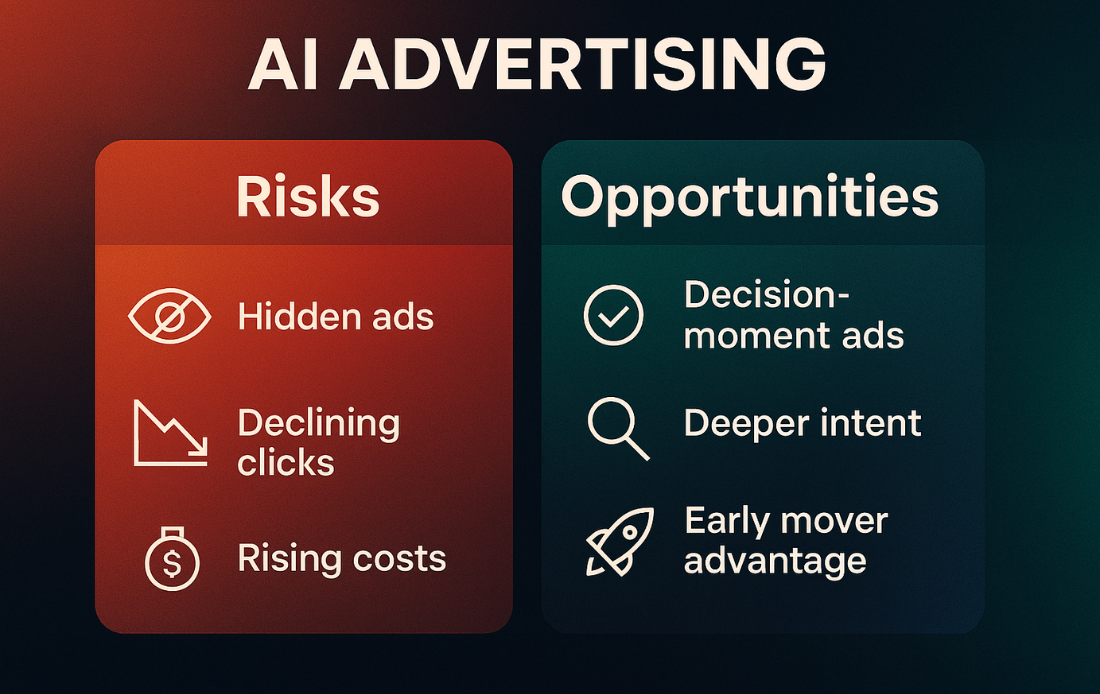
Like every big shift, there are two sides:
Risks
- Ads may blend so seamlessly into answers that users don’t always realise they’re sponsored.
- Click-through rates could decline if purchases happen directly inside AI platforms.
- Measurement models may change — instead of CPC, we could see CPA (cost per action inside AI) or impression-based billing.
- Regulatory scrutiny around transparency will likely increase.
Opportunities
- Ads in AI conversations happen at the exact decision moment.
- Intent signals are 10x richer than keywords ever were.
- Early adopters will “train” AI platforms to favour their brand, making it harder for competitors to catch up later.
Small businesses with clean, consistent data could outperform bigger brands that lag in optimisation.
How Businesses Can Prepare Now
Think of this as your training plan for the AI-driven ad world:
Action | Why It Matters in AI Search |
Optimise your brand entity | Ensure your website, schema, Google Business Profile, and social presence are consistent. AI uses this data to decide if your brand is trustworthy and recommendable. |
Invest in AI-ready ad campaigns | Performance Max and Search campaigns already feed signals into AI Mode. Running them now helps train the system with your best customer data. |
Update your product feeds | Go beyond specs. Structure product data to answer conversational queries like “Is it long-lasting? Inspired by luxury? Versatile for day and night?” |
Build trust signals | Reviews, case studies, and authoritative content aren’t just for people — they’re proof for AI systems that your brand is credible. |
Test and track smarter | Don’t just measure leads. Track which leads convert and repeat. Feeding this back teaches AI who your high-value customers are. |
Partner with AI-focused specialists | Most agencies stop at page-one rankings. Phoenix Wolf blends SEO, ads, and Intelligent Visibility Optimisation (IVO) to prepare you for AI conversations. |
The businesses that treat their presence like a training ground for AI will be the ones dominating tomorrow’s ad landscape.
Stay Competitive in the AI-Driven Ad Era
AI advertising isn’t science fiction. It’s rolling out now. Google has already briefed agencies on ads in AI Mode, with wider rollout expected by the end of 2025. Apple and OpenAI aren’t far behind.
At Phoenix Wolf, we’re helping brands prepare for this shift by combining Google Ads, Meta Ads, and Intelligent Visibility Optimisation, to make sure our clients aren’t just visible today, but competitive in tomorrow’s AI-driven ad landscape.
Ads in AI conversations aren’t a maybe – they’re inevitable. The businesses that act now will be the ones AI learns to favour tomorrow.
Ready to future-proof your advertising? Partner with Phoenix Wolf and stay ahead in the AI era.